The wife and I went to see the reincarnation of Disney’s Beauty and the Beast.
It was okay.
The main story was still good. The movie was successful in that it conveyed the story. I laughed, I cried, etc.
But it was annoying in some aspects. I had known about the changes to LeFou, and I’m not going to discuss that aspect much – only to say that it was more of a distraction that anything else. I’ll liken deciding to watch this movie to what I heard a number of people say about voting for Trump. They did it in spite of his issues, not because of it, because it’s better than the alternative. Except in this case there were many alternatives and none of them was Hillary, so maybe the analogy breaks down there.
I had 3 main complaints about how the movie was inconsistent. Not necessarily inconsistent with the original movie, but rather inconsistent with itself.
- Claims of Live Action : The big selling point of this movie is that it was a live-action version of the animated classic. Come see the movie you love, but with people doing the acting – it’s not animated! They might not have said those words directly, but that was the feeling that was portrayed.
Except…
The Beast was computer-animated, Lumiere and Cogworth were computer-animated, Mrs. Potts and Chip were computer animated, as were the wardrobe lady and the piano guy and the footstool dog and so on.
It’s hard to accept that a movie is live action when so many of its main characters are not.
And I didn’t like the CGI, especially with Lumiere. And the Be Our Guest song. And the Beast’s gait. You get the idea – it was distracting.
- Setting and Accents : Was this set in England or France or America? The story says it’s in France, and part of it takes place in Paris. There are some French phrases thrown in for good measure. But only Lumiere attempts to have a French accent. Belle has a decidedly British accent, and the other main characters sound American. Of course, the best choice would be to have everyone with a French accent. But it wouldn’t have bothered me if everyone had a British accent, or American accent. If the movie is consistent, I wouldn’t notice it. But when the acecnts are all over the place, it is a distraction.
- Progressive and Oppresive Villagers : I think I understand the director’s/producer’s intention behind casting people of different races, but again it was inconsistent with the story and was more of a distraction. It was inconsistent because those villagers must have been very progressive not only to allow different races to have prominent roles but also to accept mixed-race marriages. (Although the races were only combinations of blacks and whites – didn’t see many Asians in there.) Since the setting is 18th-century France, it was anachronistic. But let’s give the director the benefit of the doubt and assume he was just trying to promote racial harmony and was using this movie as the vehicle to do so. But then we see these same villagers oppress Belle because she dares to teach a girl to read.
In the original movie, the “provincial” villagers seemed rather indifferent – they thought Belle was odd but didn’t think much of it, and certainly didn’t teach her a lesson for going against the village’s unwritten rules. But this new adaptation of the movie makes the villagers both more progressive and less progressive. Why couldn’t the director have the villagers be supportive of girls’ education? If this movie was to be the means by which equality and tolerance are promoted, why only with the subject of race and not with gender? Again, inconsistent.
One more thing that bothered me was the choice of fuzzy camera focus during pans. Things went extra fuzzy/blurry when the camera was moving. I assume this was the director’s choice, as I haven’t noticed it in other movies I’ve seen. I disagree with that choice, since it happened a few times and each time it took my mind out of the story because my mind was trying to figure out what went wrong with my eyes. Again, a distraction.
The movie wasn’t bad, overall. It just had a number of things wrong with it. See it if you want. But if you want your kids to see a good movie, just show them the original animated version.
Immediately the word concerning Nebuchadnezzar was fulfilled; and he was driven away from mankind and began eating grass like cattle, and his body was drenched with the dew of heaven until his hair had grown like eagles’ feathers and his nails like birds’ claws.
Daniel 4:33
Posted in Life | Leave a Comment »


We had a nice spring day last weekend, so we took the family to the local botanical gardens. They are not a scenic as they would be during the summer when more things are in bloom, but it was still good for the kids to get out and about.
Here are photos of the various paths, ranked from best to worst for walking with kids.

Read the rest of this entry »
Posted in Family, Life | 1 Comment »
Since graduation season is just around the corner, there may be commencement speakers who are starting to write their speeches. I expect that most of those speakers were chosen because of some skill or accomplishment, which indicates they have the capacity to plan ahead and write well.
But for those commencement speakers who like to fly by the seat of their pants and are looking for some last-minute help, here is a handy guide.
The go-to phrase for graduation speeches is something about how the wish is for the students to not just survive, but thrive.
Don’t use that phrase.
I’m sure it wasn’t so bad the first dozen times, but now everyone has tired of hearing it.
My suggestion: find a different word from thrive.
That will throw off the audience. Start with the “not just survive” bit, but change it. Here are some other words that rhyme with survive.
- strive
- drive
- chive
- jive
- dive
- five
- hive
- alive
These words might or might not make any sense for your graduating class. But at least the audience won’t tune out the rest of the speech like they would with “thrive”.
Any other suggestions?
The others came out from the city to encounter them, so that they were trapped in the midst of Israel, some on this side and some on that side; and they slew them until no one was left of those who survived or escaped.
Joshua 8:22
Posted in Ideas | 1 Comment »
There’s a company logo based on the Titanic. They won’t admit it, of course, but I found the connection.
First off, the Titanic:

Next, the Titanic as it is sinking (artist’s rendering):

Finally, the corporate logo:

Looks about right, doesn’t it?
so they signaled to their partners in the other boat for them to come and help them. And they came and filled both of the boats, so that they began to sink.
Luke 5:7
Posted in Mishaps | Leave a Comment »
The cereal companies have their brands pretty well established. Everybody knows the brand names, and the kids are familiar with how they taste. In order to save money on the kids’ cereals (which is in order to spend that money on my fancy granola (Berries and Dark Chocolate Love Crunch)), I’ll buy store brands when it makes sense.
The store brands are always cheaper, but it doesn’t always make sense to buy them. If the kids don’t eat them, then it was a waste of money to buy them.
Brand Names that are …
Copied Well
- Frosted Mini Wheats
- Honey Bunches of Oats
- Special K Red Berries
Copied Ok
- Frosted Flakes
- Cocoa Pebbles
- Instant Oatmeal
Copied Poorly
- Honey Nut Cheerios
- Life
- Lucky Charms
Your store brands may not align with this assessment, because I don’t know which stores you frequent. Mine are Kroger and Meijer.
Beloved, do not imitate what is evil, but what is good. The one who does good is of God; the one who does evil has not seen God.
3 John 1:11
Posted in Food | Leave a Comment »
I thought I was safe.
I got the Home Depot credit card so I would be left alone. When the cashiers would ask if I would be paying with a Home Depot credit card, I could answer “Yes” and then I wouldn’t be asked if I would like to get one.
I also have a good answer for when one of their specialists is standing in the main aisle and asks me about my furnace. I don’t have a furnace, so I don’t need it tuned/replaced/fixed/updated/serviced or anything. The house is heated via a combination of hot water and electric baseboard and burning corn. But that’s another topic.
Last week I was buying some routine items from Home Depot and the cashier asked me if I would be paying with a Home Depot credit card. “Yes,” I answered, secure in my immunity from further questioning.
“Would you like to add another authorized user?” she continued.
What is this? Are they never happy?!?!
“No thanks.”
Maybe the Pro Desk cashier doesn’t have to ask upselling-type questions. I’ll try that check-out and see. If they do, then I’ll have to stick to the self check-out lanes.
I tell you, even though he will not get up and give him anything because he is his friend, yet because of his persistence he will get up and give him as much as he needs.
Luke 11:8
Posted in Life | 1 Comment »
We met some acquaintances at a state park: Nelson Ledges.
It’s a fun place for kids and a stressful place for parents. If you read my review of Letchworth State Park last year, this may sounds familiar to you.
Nelson Ledges is a scenic place, although on our day there were a number of rambunctious and/or reckless teenagers (or they could have been in their lower 20s, but I don’t have a good term for them that fits like “crazy teenagers” does).
Now for the pictoral tour through Nelson Ledges:
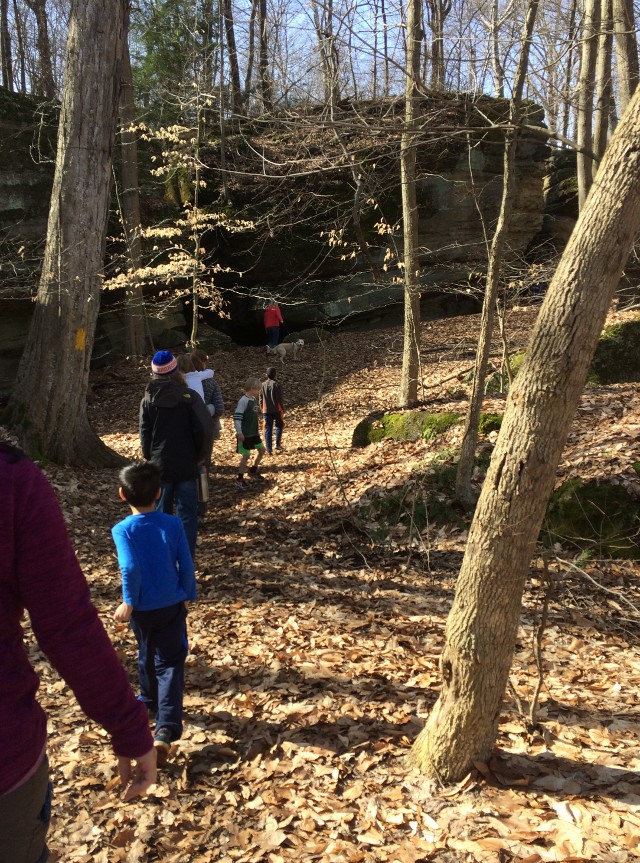
This was the start – just a walk along a forest path.
Read the rest of this entry »
Posted in Travel | Leave a Comment »

 This is Alpha, the first-born, when he was 2YO.
 This is Beta, the second-born, when he was about 2YO.
 This is Gamma, the third-born, when he was about 18MO.